A faceless video has nothing to hide behind. There is no presenter to charm the viewer through a slow opening, no reaction shot to cover a weak line, so the script carries the whole video: the narration, the pacing and what appears on screen. This guide gives you a faceless video script structure you can reuse on every upload: the hook, the retention beats, word counts per duration, a visual cue on every line, the ending, and how to use AI for the draft without publishing something generic. One example runs through every step: a 45-second Short for Strange Seas, a faceless ocean-facts channel.
Want the video, not just the script? ClipNova's script to video AI turns a pasted script into a narrated, captioned video with a scene for every beat, or writes the script for you from a topic. The Faceless Reels runs on the same engine, set up for faceless Shorts, Reels and TikToks.
What a faceless video script has to do
A script for a talking-head video only has to say the right things. A faceless script has three extra jobs:
- Hold attention with words alone. The first line has to earn the second, because nothing else on screen asks the viewer to stay.
- Direct the picture. Every line needs a visual the viewer can see while it is spoken. If you cannot picture the scene, the generator or editor cannot either.
- Fit the clock. Narration runs at roughly 150 words a minute. A 45-second Short is about 110 words, and every extra word is a sentence the viewer has to wait through.
- Sound like one channel. Same narrator, same rhythm, same kind of ending, so a viewer recognises you without a face.
The example: Strange Seas
Strange Seas posts one surprising ocean fact a day as a vertical Short on YouTube Shorts, TikTok and Reels, plus one 4 to 5 minute horizontal video a week. The video we script here is "Why an octopus has three hearts", 45 seconds long, calm male narrator, documentary-style underwater visuals and bold captions. Everything below is the writing plan for that one Short, and the same plan scales to the weekly long video.
Step 1: Write the payoff before the hook
Scripts sag in the middle when the writer does not know where they end. Decide the single thing the viewer should walk away with, in one sentence, before you write a word of narration.
- Research the topic until you can state the surprise plainly.
- Write the payoff line: the fact, twist or lesson the video exists to deliver.
- Cut every fact that does not lead to it. One Short, one idea.
Applied to Strange Seas: the research turned up a dozen octopus facts (the blue blood, the color changing, the three hearts). Only one has a payoff with a twist in it: the octopus has three hearts, the main one stops beating when it swims, so it mostly crawls. Payoff line: "Three hearts, and it would rather walk." Everything else goes on the idea list for another video.
Step 2: Set the length, then the word budget
Pick the duration first and let it cap the word count. Most narrators land between 140 and 160 words a minute; 150 is a safe planning number.
| Length | Narration words | Structure that fits |
|---|---|---|
| 15 s | 35 to 40 | Hook, one fact, payoff |
| 30 s | 70 to 75 | Hook, two beats, payoff |
| 45 s | 105 to 115 | Hook, three or four beats, payoff, loop line |
| 60 s | 140 to 150 | Hook, four or five beats, payoff, short CTA |
| 3 min | 420 to 450 | Cold open, promise, three chapters, payoff, CTA |
| 5 min | 700 to 750 | Cold open, promise, four or five chapters with re-hooks, payoff, CTA |
Write under the budget: pauses and emphasis need air. Strange Seas had 110 words for 45 seconds and finished at 108.
Step 3: Write the hook as the first line, not an introduction
The first one to three seconds decide whether the viewer swipes. "Today we are going to talk about octopuses" spends that window on nothing. Open with the most surprising thing you know, stated as plainly as possible.
| Hook pattern | Example |
|---|---|
| A claim that sounds wrong | "This octopus has three hearts. And when it swims, one of them stops." |
| Number plus stakes | "Three ocean animals that would not survive your bathtub." |
| A question aimed at the viewer | "Could you hold your breath longer than a sperm whale dives?" |
| Mid-action start | "The shark has been following this boat for six hours." |
| Visual contradiction | "This is not a rock. Watch." |
Rules for any pattern: under 15 words, no greeting, no channel name, and a first frame that shows the claim. Strange Seas uses the claim that sounds wrong.
Step 4: Add a turn every few seconds
Retention drops at the moments where nothing new happens. In a Short, give the viewer a new piece of information or a shift in direction roughly every 5 to 8 seconds. In long videos, add a re-hook at the start of every chapter, a line that restates the question and promises the answer is close.
Words that create turns: "but", "so", "here is the catch", "which means", "until". Words that kill them: "basically", "in this video", "as I said".
Applied to the example, the beats are:
- 0:03 the two gill hearts and their one job
- 0:10 the third heart, with "keep an eye on that one" as an open loop
- 0:18 the turn: octopus blood is blue and carries less oxygen than ours
- 0:26 the catch: the third heart stops when it swims
- 0:36 the payoff
Step 5: Put a visual cue next to every line
Write the script in two columns: what the narrator says and what the viewer sees. Skipping this is why so many faceless videos look like loosely related stock clips. A cue is one short, concrete description: subject, action, framing.
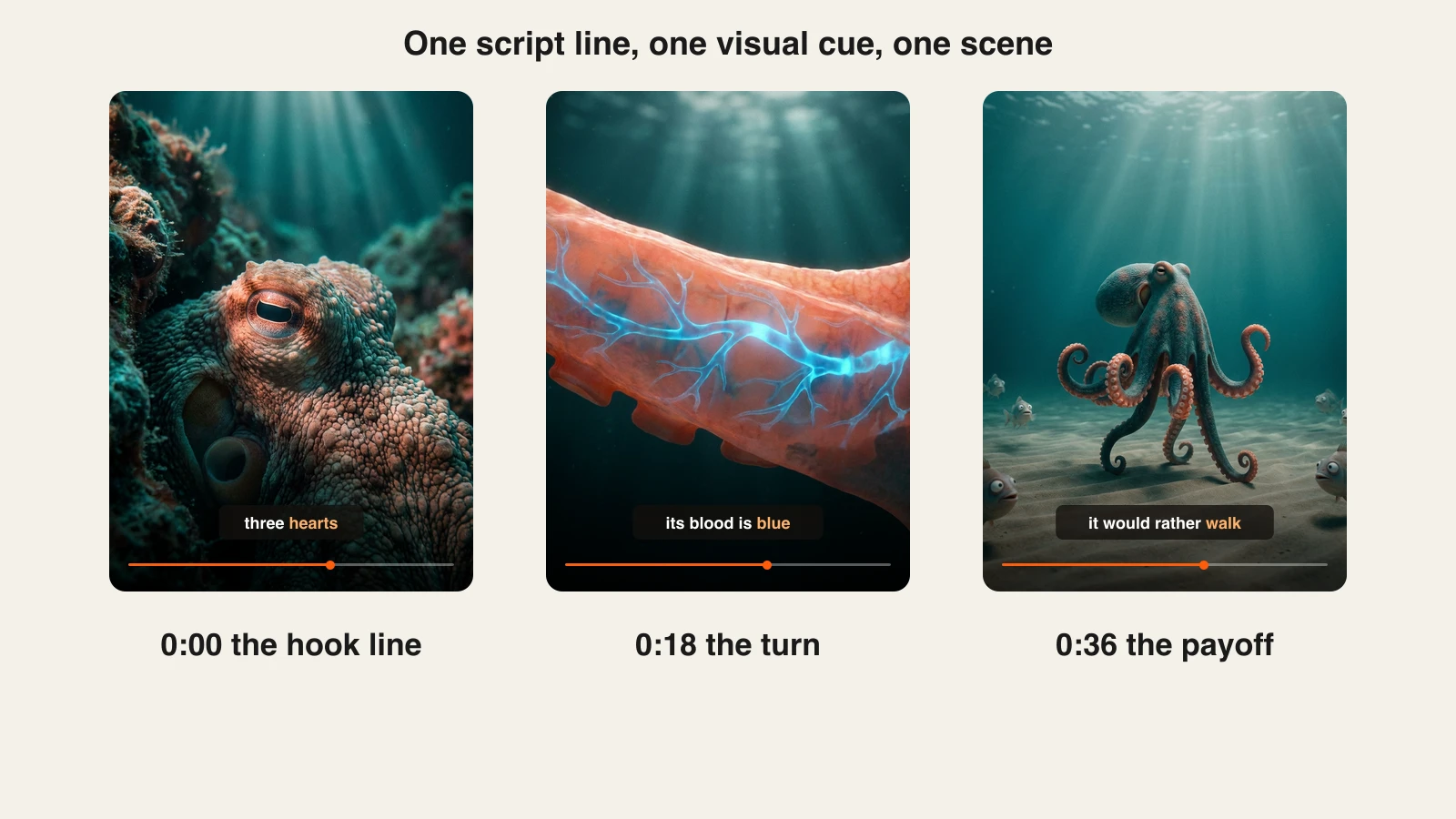
Good cues name something the camera can show ("macro of blue blood moving through vessels"), not a mood ("science vibes"). When the narration says a number or a name, the cue should show it, so a viewer watching on mute still follows. If you paste a two-column script into ClipNova, the visual notes you write decide what each scene shows and any timings you include set the length of the video, according to its script to video page.
Step 6: End with a payoff, then a loop or a CTA
The ending decides two numbers: whether the viewer watches again and whether they follow. Deliver the payoff in one sentence, then choose one of these, never both:
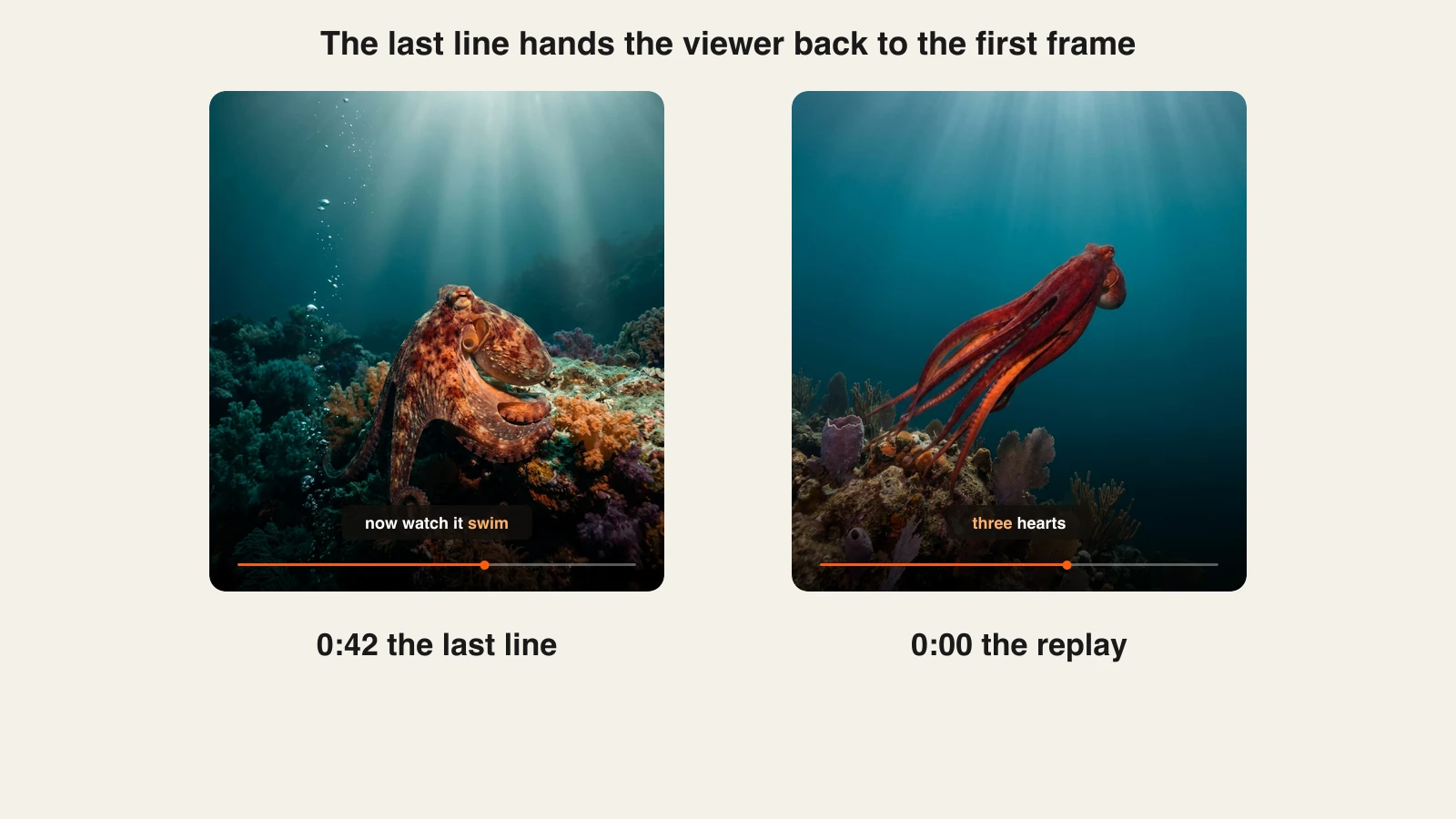
- Loop line (Shorts): a last line that sends the viewer back to the first frame. "Now watch it swim again" works because the opening shot is the octopus swimming.
- Question CTA: a specific question that invites a comment ("Which animal should be next?").
- Follow CTA: a promise, not a request. "One strange sea fact every day" gives a reason to follow.
- Next-video CTA (long-form): name the next video and why it continues this one.
Step 7: Draft with AI, then edit for originality
AI is good at a first draft and bad at sounding like your channel. Give it the structure, not just the topic:
Write a 45-second faceless YouTube Short script (about 110 words) about why an octopus has three hearts.
Format: two columns, narration and visual cue, with timestamps.
Open with a claim that sounds wrong, under 15 words. A new fact every 5 to 8 seconds.
End on this payoff: "Three hearts, and it would rather walk." Then one loop line.
Calm documentary narrator. No greetings, no "in this video".
Then edit, in this order:
- Check every fact against a source you trust. AI drafts state wrong numbers with total confidence.
- Replace the hook if it could open any video in your niche.
- Add your angle: one line of opinion, comparison or humour only your channel would write.
- Read it aloud with a timer and cut until it fits the budget from Step 2.
- Vary the shape from your last few videos. YouTube treats repetitive or mass-produced content as ineligible for monetization under its inauthentic content policy, so a template is a starting point, not a mould.
Step 8: Turn the script into a video
Once the script is locked, production is the quick part:
- 1. ClipNova: paste your script, or give it a topic and let it write one. It voices the narration, generates a scene for each beat, burns in captions and adds music, in 9:16 or 16:9, in many styles, with a choice of models such as Sora 2, Veo and Kling. Its voiceover is written from your script: your lines and story stay, timings and scene labels are not read out. In the scene editor you can rewrite a single narration line or swap a scene without redoing the video. Long scripts render up to 5 minutes on Starter and above, and exports are watermark-free 1080p or 4K with commercial rights. There is no auto-posting; you review and post yourself. Plans from $19/mo.
- 2. The Faceless Reels: the same engine set up for faceless short-form only. Pick the format and style, drop in the script or idea, and get a narrated, captioned Short, Reel or TikTok to review. The quickest path if everything you make is vertical short-form. Same plans, from $19/mo.
For Strange Seas, the 45-second script went in as written, with the documentary style and the same narrator saved for every upload.
Reusable faceless video script templates
Copy the one that fits, fill the brackets, then edit per Step 7.
Template 1: the fact reveal (30 to 45 seconds)
0:00  HOOK: [the claim that sounds wrong]          VISUAL: [the subject, doing the thing]
0:03  SETUP: [what most people assume]             VISUAL: [the ordinary version]
0:10  TURN: But [the surprising detail]            VISUAL: [close-up on the detail]
0:20  WHY: [the reason, one sentence]              VISUAL: [the mechanism, shown]
0:30  PAYOFF: [the one-line takeaway]              VISUAL: [the strongest image]
0:40  LOOP: [a line that points at the opening]    VISUAL: [cut to frame one]
Template 2: the story with a twist (45 to 60 seconds)
0:00  HOOK: [the moment things went wrong]         VISUAL: [the scene, mid-action]
0:04  CONTEXT: [who, where, in one line]           VISUAL: [the place]
0:12  ESCALATION 1: [it gets worse]                VISUAL: [the new problem]
0:24  ESCALATION 2: [it gets worse again]          VISUAL: [the stakes]
0:36  TWIST: [what nobody saw coming]              VISUAL: [the reveal]
0:48  VERDICT + CTA: [one line, then a question]   VISUAL: [the aftermath]
Template 3: the countdown (45 to 60 seconds)
0:00  HOOK: [number] [things] that [stakes]        VISUAL: [the boldest of the three]
0:04  #3: [item] plus one fact                     VISUAL: [item 3]
0:16  #2: [item] plus one fact                     VISUAL: [item 2]
0:28  #1: [the strongest item] plus the why        VISUAL: [item 1, longest shot]
0:48  CALLBACK: [tie #1 back to the hook]          VISUAL: [hook image, new angle]
Template 4: the long-form explainer (3 to 5 minutes)
0:00  COLD OPEN: the most surprising moment, 2-3 sentences
0:20  PROMISE: what the viewer will know by the end
0:35  CHAPTER 1: context (re-hook line at the start)
1:30  CHAPTER 2: the main mechanism or story
2:30  CHAPTER 3: the complication or counterexample
3:40  CHAPTER 4: what it means (optional on 3-minute videos)
4:30  PAYOFF + NEXT-VIDEO CTA
For a five-minute explainer, budget about 720 words. ClipNova's long form AI video generator takes a script that length in one render.
The full example script
The finished Strange Seas script, 108 words, 45 seconds:
| Time | Narration | Visual cue |
|---|---|---|
| 0:00 | This octopus has three hearts. And when it swims, one of them stops. | Octopus jets off a reef into open blue water |
| 0:03 | Two of the hearts have one job: they push blood through the gills, where it picks up oxygen. | Slow push-in on the gills, two small glows pulsing |
| 0:10 | The third heart sends that blood to the rest of the body. Keep an eye on that one. | The glow travels from the body out along the arms |
| 0:18 | Octopus blood is blue. It carries oxygen with copper instead of iron, and it carries less than ours does. | Macro of blue blood moving through vessels |
| 0:26 | So here is the catch. When an octopus swims, that third heart stops beating. Swimming wears it out fast. | Octopus swimming, the central glow fading |
| 0:36 | That is why most octopuses barely swim at all. Three hearts, and it would rather walk. | Octopus walking across the sand on its arms |
| 0:42 | Now watch it swim again. | Cut back to the opening shot |
How long does it take to write a faceless video script?
For a 45-second Short like the octopus video:
- Research and payoff line: 10 to 15 minutes.
- AI draft from the structured prompt: 2 minutes.
- Fact check and edit: 10 minutes.
- Read-aloud timing and cuts: 5 minutes.
About 30 minutes per Short at first, closer to 15 once your templates and voice are settled. A 5-minute script takes 1 to 2 hours, most of it research. Batch Short scripts in one sitting. Turning the scripts into videos runs on plans from $19/mo, with every feature included; only the monthly credits change.
What goes wrong, and the fix
- The hook introduces instead of surprises. "Today we look at octopuses" gets swiped. Lead with the single strangest fact, under 15 words.
- Too many words for the length. The narrator rushes or the video runs long. Use the word budget table and cut adjectives first.
- No visual cues. The visuals end up generic and disconnected from the narration. Write one concrete cue per line before production.
- Three ideas in one Short. Viewers remember none of them. Keep the spares for the next videos.
- Publishing the AI draft as is. Wrong facts and the same hook shape every day. Fact-check every claim and rewrite the hook and payoff yourself.
- Every script built on the same template. The channel starts to look mass-produced. Rotate the four templates and change the ending type.
- A CTA that asks for nothing specific. "Like and subscribe" is ignored. Ask one real question or promise what the next video gives.
Write your next three scripts with Template 1 this week, time them aloud, and paste them into ClipNova's faceless video generator to see them as videos. If you are still setting up the channel itself, start with how to start a faceless YouTube channel, and to compare production tools, see the best faceless AI video generators.
Frequently asked
How do you write a script for a faceless YouTube video?
Decide the payoff first, set the length, then write a hook under 15 words, a new beat every 5 to 8 seconds, a visual cue next to every line and one ending: a loop line, a question or a follow promise. Read it aloud with a timer and cut until it fits.
How many words is a 60-second faceless video script?
About 140 to 150 words, based on a narration pace of roughly 150 words per minute. A 30-second Short needs 70 to 75 words, a 45-second Short about 110, and a 5-minute video around 700 to 750.
What makes a good hook for a faceless Short?
A first line that states the most surprising thing in the video, with no greeting or channel name, under 15 words, and a first frame that shows what the line claims. Claims that sound wrong, numbers with stakes and mid-action openings all work.
Can I use ChatGPT or another AI to write faceless video scripts?
Yes, for the first draft. Give the AI the length, the structure and the payoff, then fact-check every claim, rewrite the hook in your own words and add a line only your channel would write. Publishing unedited drafts leads to wrong facts and videos that all sound the same.
Will AI-written scripts get my channel demonetized?
Using AI is not the problem. YouTube's inauthentic content policy makes repetitive or mass-produced content ineligible for monetization, so the risk is uploading near-identical videos. Edit each script, vary the structure and give every video its own angle.
Should a faceless script include visual directions?
Yes. Write a short, concrete visual cue next to every narration line (subject, action, framing). It keeps the visuals tied to the words, helps viewers watching on mute and tells a generator or editor exactly what each scene should show.
What is the best ending for a faceless Short?
Deliver the payoff in one sentence, then use a single closer: a loop line that sends viewers back to the first frame, a specific question for the comments, or a follow promise that says what the next videos give. Asking for everything at once usually gets nothing.
Which tool turns a faceless video script into a finished video?
ClipNova takes a pasted script, or writes one from a topic, and produces the voiceover, a scene for each beat, captions and music in 9:16 or 16:9, with renders up to 5 minutes on Starter and above. The Faceless Reels runs on the same engine, set up for faceless Shorts, Reels and TikToks. Plans for both start at $19/mo.