To make ranking videos with AI, pick a list your viewers will argue about, collect the facts from one reliable source, decide number one and the hook first, map the countdown second by second, then let an AI video tool build the script, a scene per entry, the voice and the captions. Check every number before you post.
Making one top 10 video with AI takes minutes. Making one people watch to the end is harder. Countdowns have a built-in promise (stay for number one), and the AI cannot keep it for you: it will happily open with a slow intro, give every entry the same weight, and quote a river length from a source that disagrees with the one your commenters use. This guide shows how to plan a countdown so the structure does the retention work, and how to source the facts so the comments argue about your ranking, not your mistakes. One example runs through every step: Earth Ranked, a 60-second vertical Short on the five longest rivers on Earth.
Want to start now? The ClipNova AI ranking video generator turns one line of text into a finished countdown of up to 5 minutes, with a script, a scene per entry, a voice that calls each rank, captions and music, and a saved host or mascot that looks the same in every list.
What makes a ranking video work
Countdowns look easy, which is why the feed is full of bad ones. The good ones share five things:
- A hook that teases number one without giving it away. The first three seconds have to create the question the last ten seconds answer.
- A list that is arguable but checkable. "Best pizza toppings" gets comments but has no right answer. "Longest rivers" has a published ranking and a famous dispute, so people argue with facts.
- Rising stakes. Each entry should feel bigger than the last, and number one gets the most time.
- The rank on screen as it is spoken. Many viewers scroll with the sound off; the number has to be readable at a glance.
- One source for the whole list. Different sources measure differently. Mixing them gives you a ranking that no single source supports.
The example: Earth Ranked
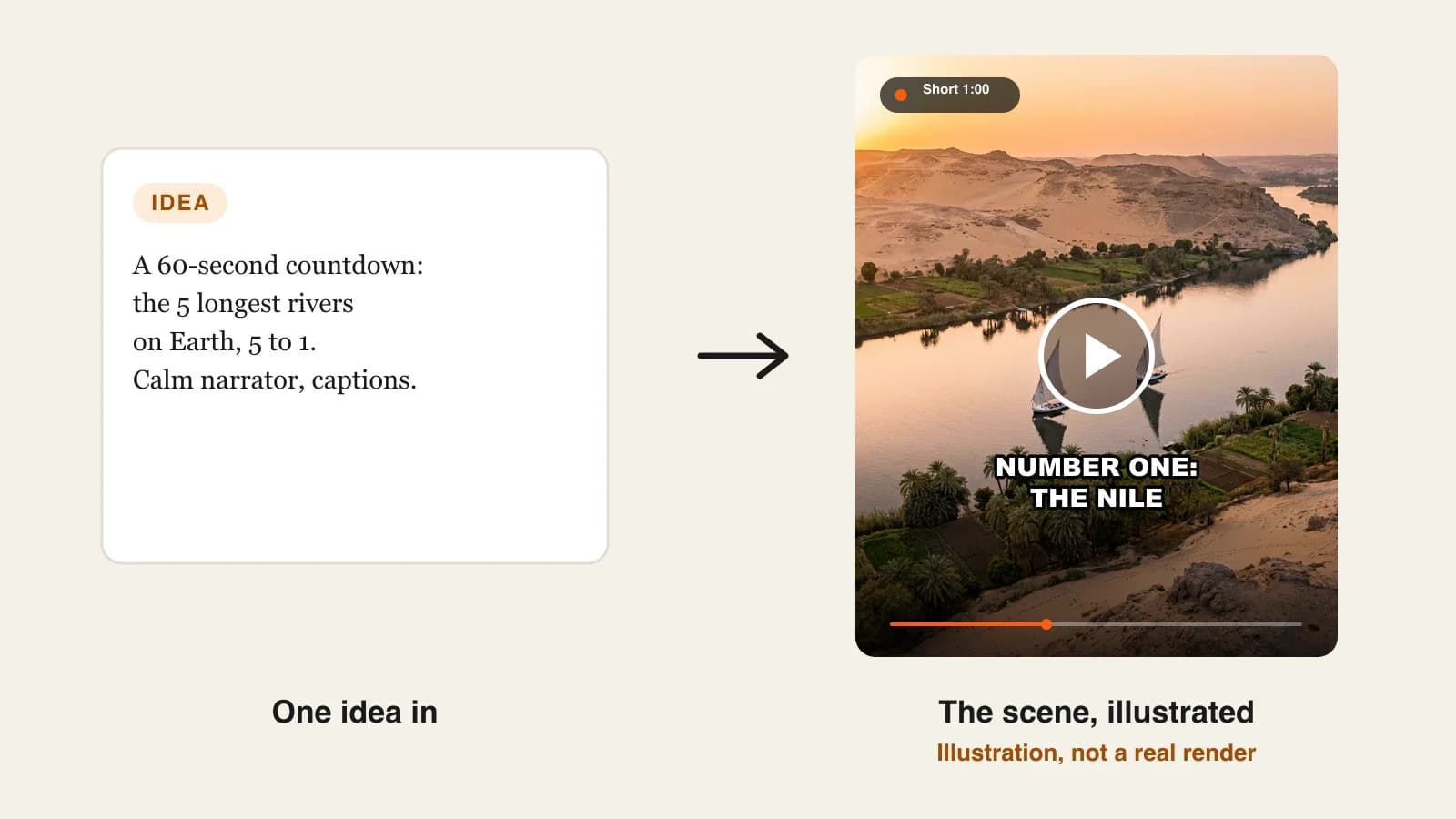
Earth Ranked is a faceless geography channel posting four countdown Shorts a week on YouTube Shorts and TikTok, with a longer top 10 on YouTube once a month. This video is "The 5 longest rivers on Earth": 60 seconds, 9:16, a calm narrator, bold captions and aerial river scenes. Everything below is the production plan for that Short.
Step 1: Pick a list your viewers can argue about
Why: a ranking nobody disagrees with gets watched and forgotten. A ranking with a real debate near the top gets watched, commented on and shared, which is what pushes it further in the feed.
Good countdown topics have three things: a measurable order, a well-known number one or two, and at least one surprise. Compare a few candidates before you commit:
| Topic | Measurable? | Debate? | Surprise? |
|---|---|---|---|
| Best pizza toppings | No | Yes, but opinion only | Low |
| Tallest mountains | Yes | No, Everest wins | Low |
| Most remote inhabited islands | Yes, but distances vary by method | Some | High |
| Longest rivers | Yes | Yes, Nile vs Amazon | Medium |
Applied to the example: Earth Ranked picks the longest rivers. The order is published, the top two are household names, and there is a real scientific debate about which one is longer, which gives the video its hook and its outro question.
Step 2: Source every number before you write a word
Why: AI script writers fill gaps with plausible numbers. In a ranking video the numbers are the content, and one wrong figure at number one becomes the pinned comment.
- Find one list that ranks every entry with the same method, such as a reference table or an encyclopedia list.
- Copy each entry and its number into a note, with the source URL.
- Look for disputes, and decide how you will say them out loud.
- Do not mix sources inside one list, even if a single entry has a "better" figure elsewhere.
- Keep the source note; you will pin it under the video.
Applied to the example: Earth Ranked uses the Wikipedia list of river systems by length, which gives the Nile 6,650 km, the Amazon 6,400 km, the Yangtze 6,300 km, the Mississippi-Missouri 6,275 km and the Yenisei 5,539 km. The Yangtze's own article gives 6,236 km, a good reminder of why you stick to one table. The same list notes that some scientists argued in 2007 and 2008 that the Amazon is longer, while a 2009 peer-reviewed study concluded the Nile is. That dispute goes into the script as a fact, not as a claim either way.
Step 3: Write number one and the hook first
Why: the hook and the payoff are a pair. If you write the countdown from number five down, you end up with a generic opening ("Here are the five longest rivers...") that gives viewers no reason to wait.
- Write number one's line first: the fact that makes it number one, plus one detail people will repeat.
- Write the hook second: tease number one without naming it, or name the obvious guess and say it is wrong.
- Write the outro last: a question that sends people to the comments.
Applied to the example:
- Hook (0:00): "The Amazon carries more water than any river on Earth. It still isn't number one."
- Number one (0:42): "Number one: the Nile, 6,650 kilometers, from the hills of Rwanda to the Mediterranean."
- Outro (0:55): "Some scientists say the Amazon is longer. Nile or Amazon: which side are you on?"
Read the hook and number one aloud back to back. If the hook makes the payoff feel obvious or unrelated, rewrite the hook, not the ranking.
Step 4: Map the countdown second by second
Why: if every entry gets the same time, the video feels flat by number three and viewers swipe before the payoff. A countdown map gives the early entries a quick, punchy line and saves time for the top two.
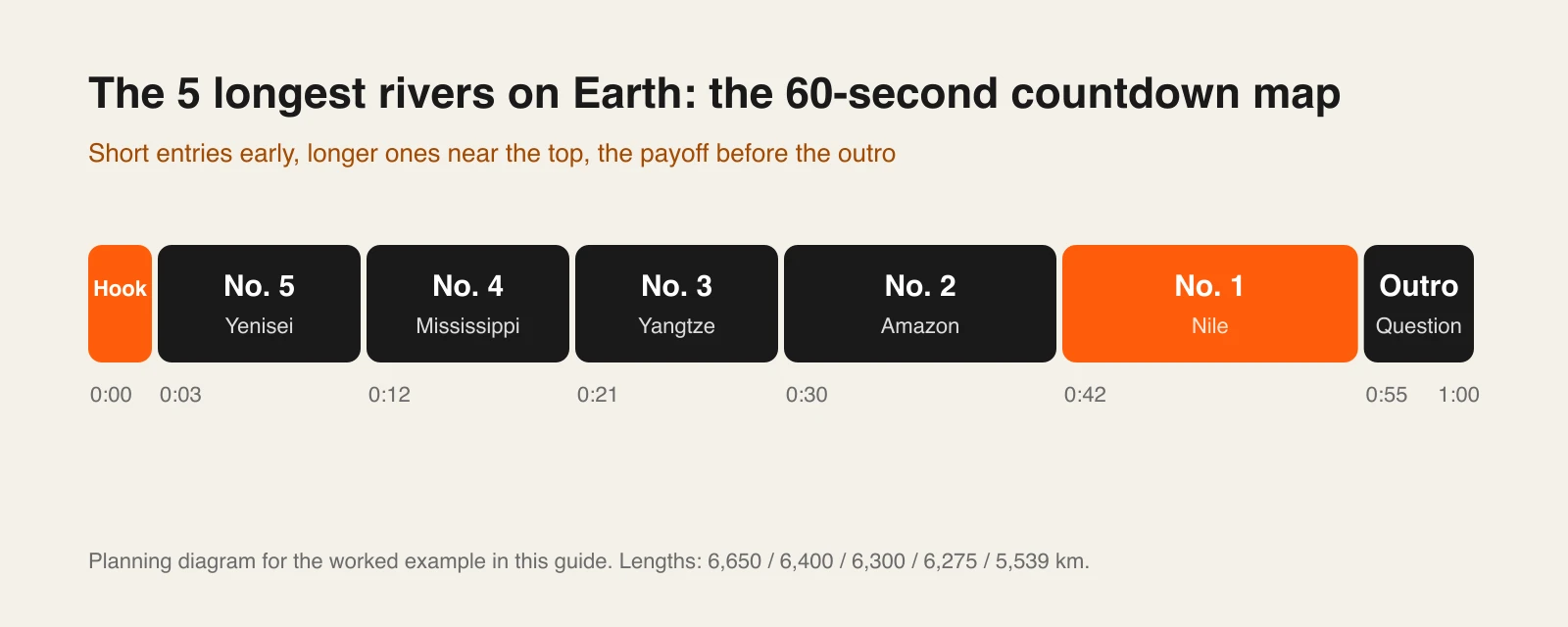
Applied to the example, the full 60-second script:
| Time | Beat | Narration |
|---|---|---|
| 0:00 | Hook | The Amazon carries more water than any river on Earth. It still isn't number one. |
| 0:03 | No. 5 | Number five: the Yenisei, 5,539 kilometers, from Mongolia to the Arctic Ocean. |
| 0:12 | No. 4 | Number four: the Mississippi-Missouri, 6,275 kilometers, from a creek in Montana to the Gulf. |
| 0:21 | No. 3 | Number three: the Yangtze, 6,300 kilometers, the longest river in China. |
| 0:30 | No. 2 | Number two: the Amazon, 6,400 kilometers. Measure it a different way, and some scientists say it wins. |
| 0:42 | No. 1 | Number one: the Nile, 6,650 kilometers, from the hills of Rwanda to the Mediterranean. |
| 0:55 | Outro | Nile or Amazon: which side are you on? |
That is about 110 words, comfortable for a calm narrator in 60 seconds with short pauses at each rank. For the monthly top 10, the same pattern stretches to two or three minutes: two lines per entry and a full fact at the top three.
Step 5: Make the countdown in ClipNova
Why: the plan is done; now one tool should turn it into scenes, a voice and captions without you cutting ten clips by hand.
1. ClipNova: the complete option for a countdown channel. ClipNova makes finished long videos with consistent characters, which for a ranking channel means:
- Long: the same workflow makes a 60-second top 5 Short and a 5-minute top 10 for YouTube.
- Consistent characters: if your channel has a host or mascot, save it once and it keeps the same face and outfit in every countdown; Series brings that cast back every episode.
- Finished: the script, a scene per entry, the voice, the captions and the music come back in one render, and Studio fixes a single entry later.
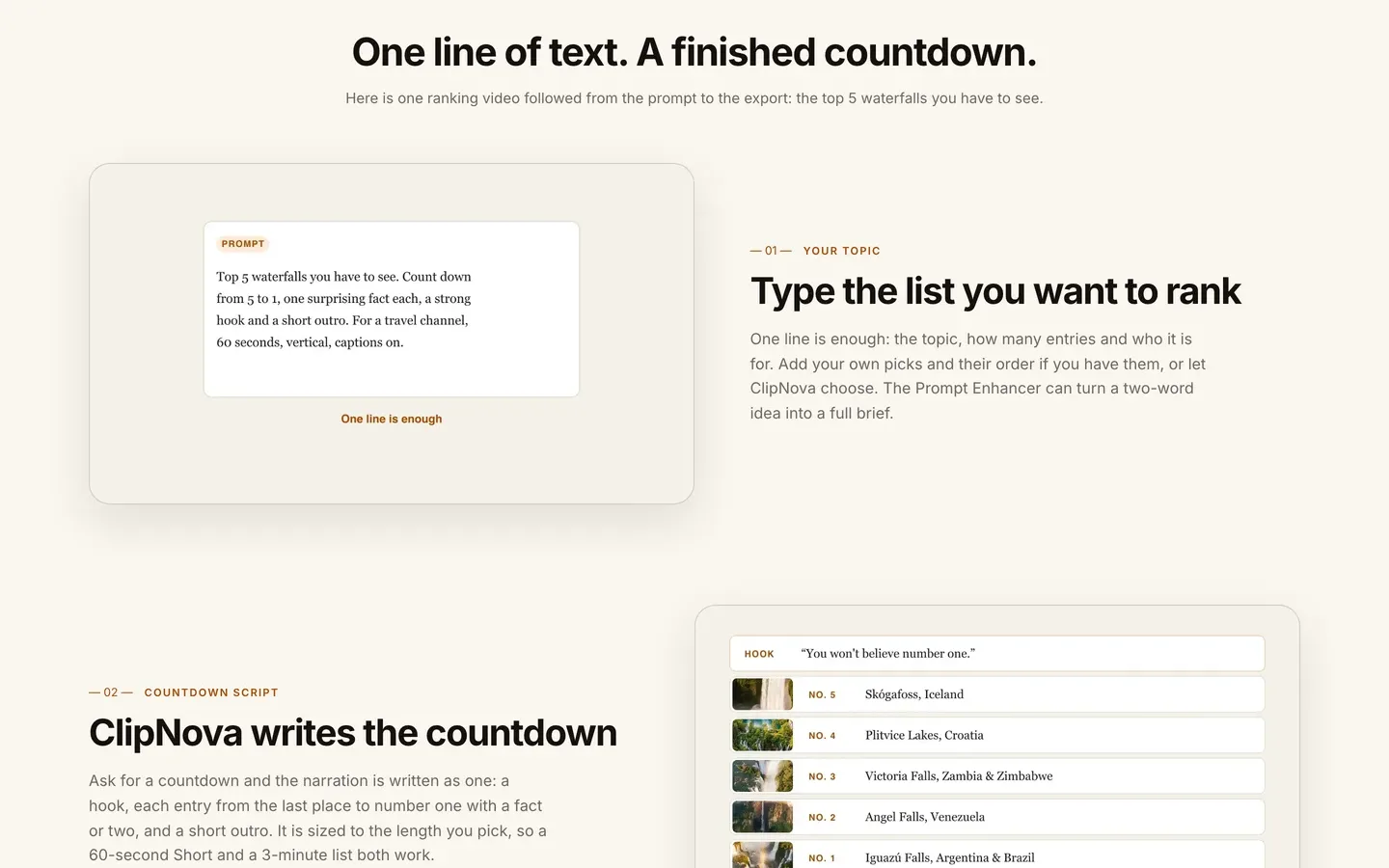
- Open the ClipNova app and start a Prompt to Video project.
- Paste your plan: the topic, "count down from 5 to 1", your five entries in order with their exact numbers, and the hook and outro lines from Step 3. If you only have a rough idea, the Prompt Enhancer can expand it, but for a fact-based list keep your own numbers in the prompt.
- Choose 9:16 and 60 seconds.
- Pick Moving AI Images for a daily Short (fast and lower cost) or AI Video for full motion, and describe the look once, for example "aerial drone shots, golden hour, documentary".
- Pick a calm narrator voice and a bold caption style, then generate.
Narration in 18 languages, plans from $19/mo and commercial rights on every plan.
Applied to the example: Earth Ranked uses Moving AI Images with an aerial documentary look. A 60-second video in Moving AI Images costs about 189 credits, so the Hobby plan ($19/mo, 1,000 credits) covers about five of these Shorts a month; four a week needs Starter or above.
Step 6: Check it with the sound off, then fix single entries
Why: a countdown can be correct in the script and still fail on screen: a caption that shows "Number three" a second late, a scene that shows a desert for a jungle river, or the wrong number read aloud.
- Watch once with the sound off. Can you follow the ranking from the captions alone?
- Watch once with your source note open. Check every number the narrator says against it.
- Check each scene matches its entry: the Amazon should look like rainforest, the Yenisei like Siberian taiga.
- Open the video in Studio and regenerate only the entry that misses.
Applied to the example: say the Yenisei scene comes back as a tropical river. Regenerate only that entry with "wide river through dark Siberian pine forest, early snow" and leave the other four as they are.
Step 7: Post it, pin the source and turn comments into the next list
- Title with the promise, not the answer: "The 5 longest rivers on Earth (number one is disputed)".
- Pin the source in the first comment or the description, with the method ("length from the farthest source").
- Disclose realistic AI scenes when they could be mistaken for real footage of a real event; YouTube asks creators to label altered or synthetic content.
- Avoid template spam. YouTube's monetization policies exclude mass-produced, repetitive content. Vary topics, keep your own voice and facts, and do not post near-identical lists.
- Mine the comments. "Do the biggest lakes next" is your next video.
For a broader posting routine, see our guide on how to make YouTube Shorts with AI.
How long does it take?
For one Earth Ranked Short:
- Topic choice and sourcing: 20 minutes
- Hook, number one and outro: 10 minutes
- Countdown map and script: 15 minutes
- Generation: a few minutes, mostly waiting
- Sound-off check and Studio fixes: 10 to 15 minutes
- Upload, title and pinned source: 5 minutes
About an hour per countdown, and less once you reuse the same look, voice and caption style every time; the channel style is one-off setup. Plans from $19/mo, with every feature included; only the monthly credits change.
What goes wrong, and the fix
- A slow opening. "Today we're looking at..." loses viewers before number five. Start on the hook line and put the title on screen instead.
- Equal time for every entry. The video peaks too early. Give the top two entries the most time.
- Mixed sources. Two numbers from two methods in one list. Use one table for the whole ranking.
- Letting the AI pick the numbers. Plausible but wrong figures. Put your sourced numbers in the prompt and check the narration.
- Captions that lag the rank. The number appears after it is spoken. Watch with the sound off and fix the entry, or shorten the line before it.
- Number one in the thumbnail or title. No reason to stay. Promise the answer, do not show it.
- Identical lists every day. Same template, same structure, different nouns. Vary formats (top 5, top 10, "ranked by...") and keep adding your own facts.
Pick tonight's list, write the hook and number one before anything else, and build the map from there. When you are ready to compare tools, our roundup of the best AI ranking video generators covers tier lists and real-footage countdowns too, and ClipNova pricing shows what each plan covers.
Frequently asked
How do I make a ranking video with AI?
Pick a list with a measurable order, collect every number from one reliable source, and write the hook and number one before the rest. Then give an AI ranking video tool such as ClipNova your topic, entries, order and numbers; it writes the countdown, builds a scene per entry and adds the voice and captions. Check every number before you post.
How long should a top 10 video be?
A top 5 fits in about 60 seconds as a Short. A top 10 with a real fact per entry usually needs two to three minutes, which suits a horizontal YouTube video. ClipNova renders countdowns of up to 5 minutes.
How do I keep viewers watching until number one?
Open with a hook that teases number one without naming it, keep the early entries short, and give the top two the most time. Show the rank on screen as it is spoken, and never reveal number one in the title or thumbnail.
Where should I get facts for a ranking video?
Use one source that ranks every entry with the same method, such as a reference table or an encyclopedia list, and keep it for the whole video. Mixing sources gives you a ranking no single source supports. Pin the source under the video.
Do I need to show my face to run a top 10 channel?
No. Ranking videos are one of the most common faceless formats: a narrator, a scene per entry and captions are enough. A saved host or mascot character can give the channel a recognisable face without you on camera.
Can I monetize AI ranking videos on YouTube?
Yes, if the videos are original and add value. YouTube's monetization policies exclude mass-produced, repetitive content, so vary your topics and formats, add your own facts and avoid near-identical template lists. Disclose realistic AI scenes that could be mistaken for real events.
How much does it cost to make ranking videos with AI?
ClipNova plans start at $19 a month for 1,000 credits, and a 60-second countdown in Moving AI Images uses about 189 credits, so Hobby covers about five Shorts a month. Every plan includes every feature; only the monthly credits change.