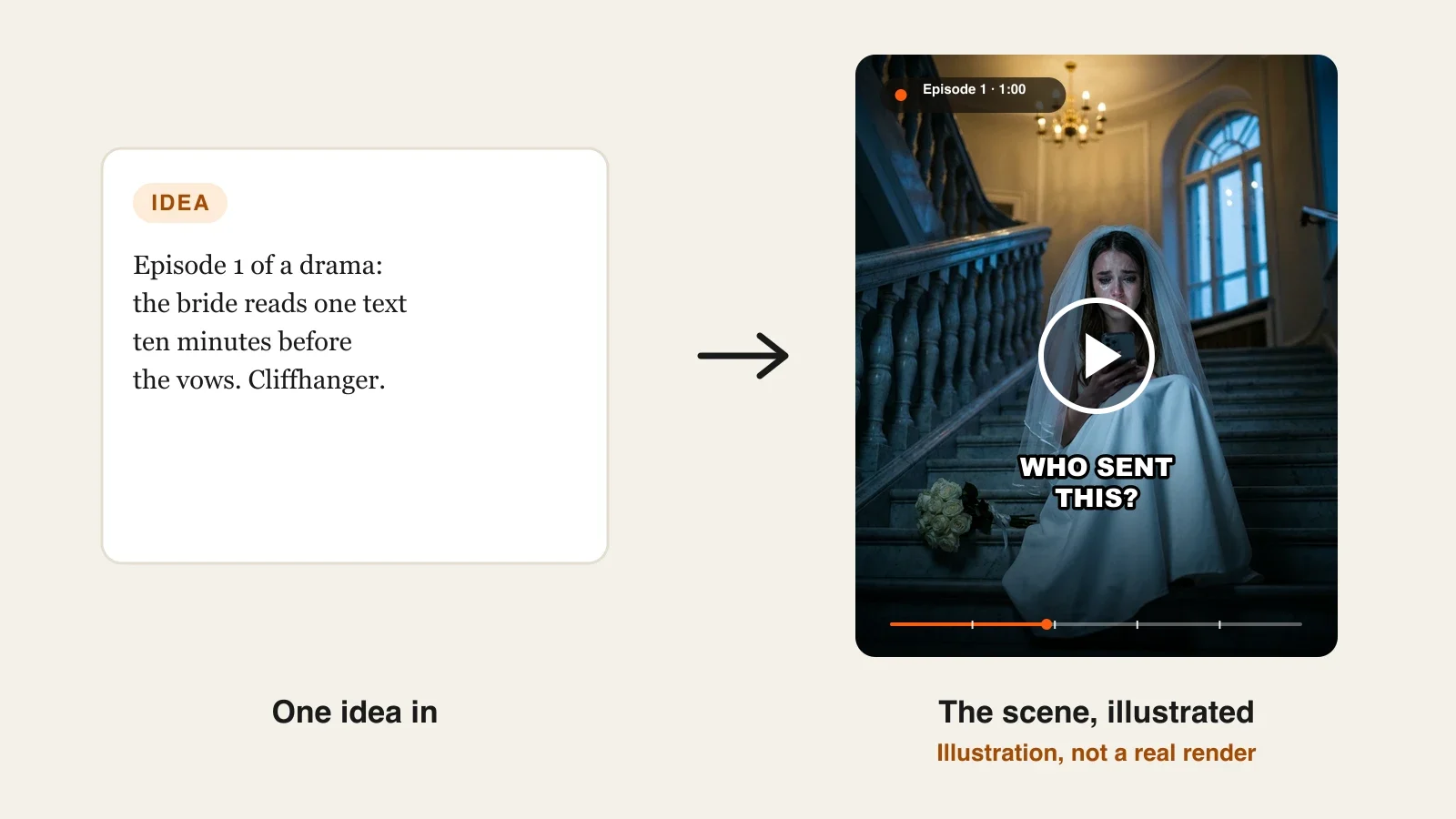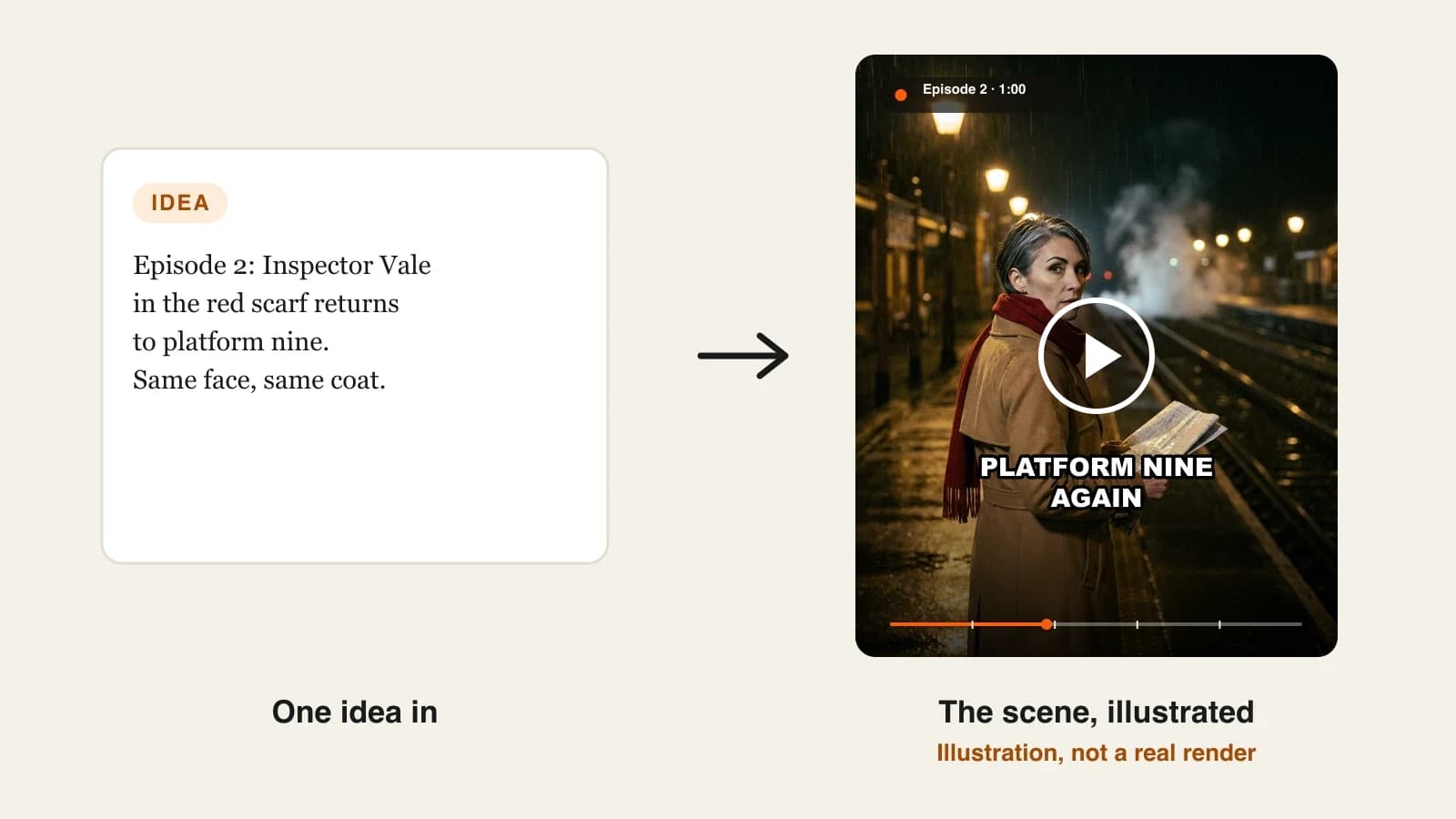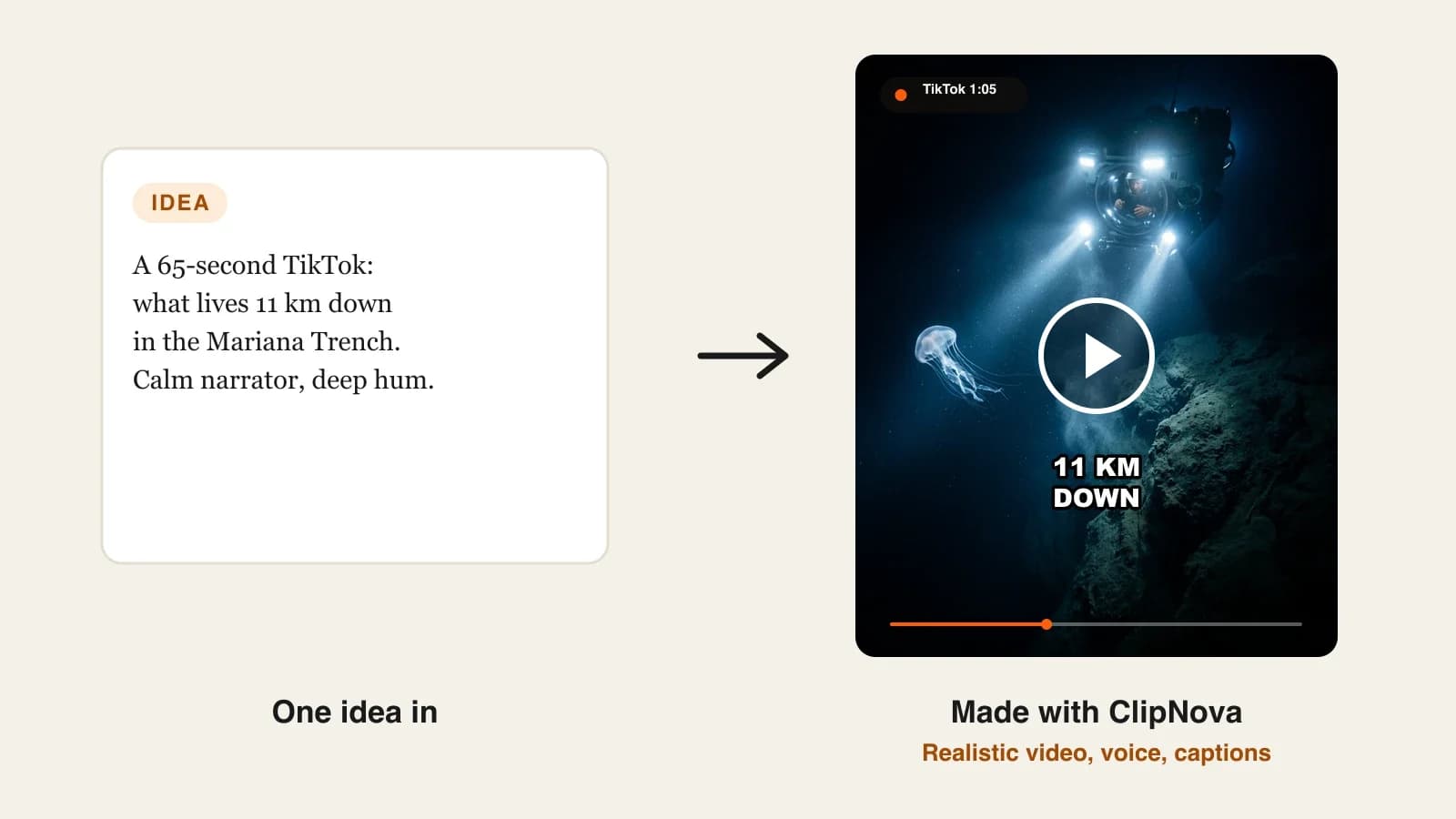
To make an AI short drama, pick one trope and one secret, cast four or five characters with fixed faces and voices, set up a vertical series with one-minute episodes, then write every episode around a three-second hook and a last line that stops at the worst possible moment. Let the characters speak their own lines on screen, fix the final shot until it lands, and post daily with the part number in the first frame.
A thirty-second AI clip of two people arguing is easy to make. A drama people follow for twenty episodes is not. Viewers come back for three things: faces they recognise, a secret that keeps getting closer, and an ending that makes them need part 2. No tool invents those for you. What a series tool can do is keep the faces, remember the plot and render each episode with dialogue, so your job shrinks to the part that makes drama work: the story beats. This guide covers the whole job, from the premise to posting episode 3. One example runs through every step: The Quiet Heir, a vertical micro-drama about a housekeeper who finds out she belongs to the family she cleans for.
Want to start now? ClipNova's AI short drama generator turns a line or two of story into a finished vertical episode of up to 5 minutes: the same cast in every scene, characters who say their lines with lip sync, captions and music, and a memory of what happened in earlier episodes.
What makes a short drama binge-worthy
- A secret the audience is waiting on. Every great micro-drama is a slow reveal: who the heir is, who sent the text, who really owns the company. Each episode gives one clue and withholds the rest.
- Conflict in the first three seconds. No establishing shots. Open on the slap, the envelope, the overheard line.
- Dialogue, not description. Short drama is people saying cutting things to each other's faces. A narrator works for mood, but the big moments belong to the characters.
- Faces that never change. The heroine in episode 15 must be the woman from episode 1, or the spell breaks.
- An ending that cuts too early. The last line or shot is the reason to watch the next one.
The example: The Quiet Heir
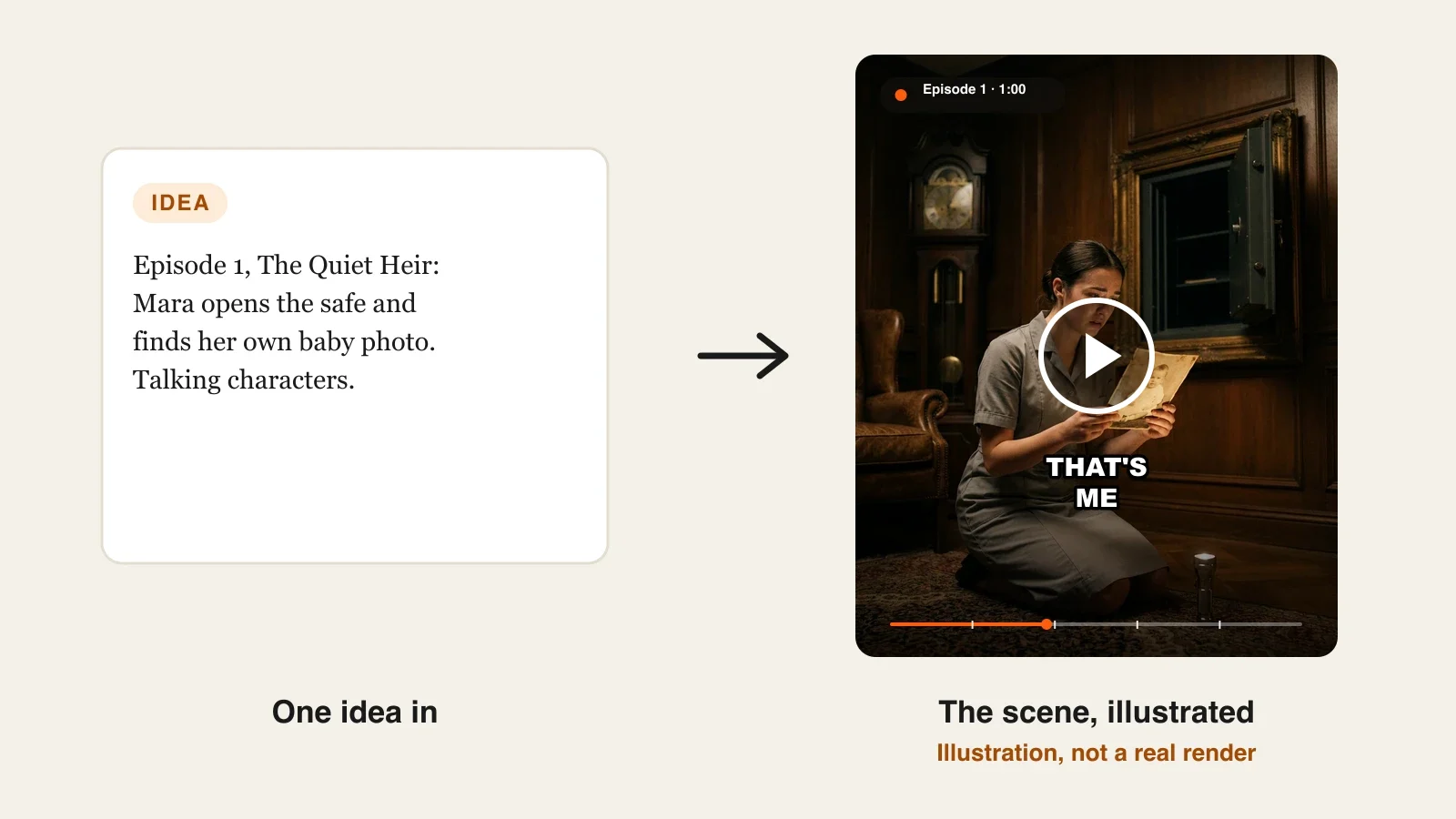
The Quiet Heir is a 20-episode vertical drama for TikTok, Instagram Reels and YouTube Shorts. Each episode runs about one minute in 9:16, realistic in look, with the characters speaking their lines on screen. One episode goes out every day at the same time. Mara Quinn, 26, has cleaned the Ashford mansion for three years. In episode 1 she opens the late patriarch's safe and finds a photo of herself as a baby. Everything below is the production plan for that drama.
Step 1: Pick one trope and write the secret first
Why: micro-drama audiences pick shows by trope (hidden heir, contract marriage, revenge comeback). A clear trope tells them in one second what they are watching. The secret is the engine: it decides what every episode reveals.
- Choose one trope and stick to it for the whole season.
- Write the premise in one sentence: who wants what, and what stands in the way.
- Write the secret in one sentence, and the episode where it finally comes out.
- List five clues that lead to it, one every few episodes.
Applied to the example:
- Trope: hidden heir.
- Premise: a housekeeper discovers she may be the Ashford family's lost daughter, while the widow who runs the house will do anything to keep the estate.
- Secret: Mara was switched at birth on the night Celeste Ashford's own baby died, and the old head housekeeper helped hide it. Revealed in episode 18.
- Clues: the baby photo (ep 1), a hospital bracelet (ep 4), Mrs. Pell lying about a date (ep 7), a will with a blank name (ep 11), a nurse's name on an old hospital record that Mrs. Pell recognises (ep 15).
Step 2: Cast four or five characters, with faces and voices
Why: a small cast keeps every face consistent and every relationship clear. Short drama is built on pairs: lovers, rivals, a keeper of secrets.
| Character | Role | Look | Voice |
|---|---|---|---|
| Mara Quinn | The heroine | 26, dark hair tied back, grey housekeeper's uniform | Soft, steady, sharp when cornered |
| Celeste Ashford | The widow and antagonist | 50s, silver bob, pearls, cream silk blouse | Cool, precise, never raises it |
| Julian Ashford | Celeste's son, drawn to Mara | 30, tousled brown hair, open-collar shirt | Warm, a little tired |
| Mrs. Pell | Head housekeeper, keeper of the secret | 70, white bun, black dress, reading glasses | Low, careful, pauses before answering |
| Theo Grant | The family lawyer | 40s, navy suit, wire glasses | Clipped and formal |
Applied to the example: each of the five is saved once with a name and a picture, and given a voice so they can speak on screen. A ClipNova series holds up to 8 characters, which leaves room for a rival or a long-lost father later in the season.
Step 3: Set up the show from the Drama series template
Why: a drama has to look and sound the same every day. Choosing the look, length and captions once means episode 20 matches episode 1 without effort.
1. ClipNova: the complete option for a drama with a recurring cast. ClipNova makes finished long videos with consistent characters: episodes from 30 seconds up to 5 minutes, the same five faces in every scene of every episode, and dialogue, captions and music done in each render.
- Open Series, name the show (The Quiet Heir), describe it in one line, and pick Drama series. The template sets a realistic look, the vertical 9:16 format and one-minute episodes.
- Keep the realistic look, the one-minute length and burned-in captions, then pick the language the voices speak.
- Choose the quality. Talking characters run on AI Video at Base (768p) or Pro (1080p).
- Add the five cast members from Step 2, each with a name, a picture (upload one, pick a saved character or create a new one) and a voice.
Applied to the example: The Quiet Heir runs on Pro for sharper faces in the close-ups that drama lives on. Plans from $19/mo, and Series is included on every plan.
Step 4: Plan every episode on a four-beat structure
Why: one-minute episodes have no room for wandering. A fixed structure makes them fast to write and keeps the rhythm viewers expect.
| Time | Beat | Applied to episode 1 |
|---|---|---|
| 0:00 to 0:03 | Hook: the most charged image or line | Mara's hand on the open safe door at midnight |
| 0:03 to 0:30 | Pressure: why this matters, who is in the way | Footsteps in the hall; Celeste is awake |
| 0:30 to 0:50 | Turn: the reveal or the confrontation | Mara finds the photo; the baby has her birthmark |
| 0:50 to 1:00 | Cliffhanger: stop before the answer | Celeste in the doorway: "Put that back." |
Write the cliffhanger line for all 20 episodes before you make any of them. If a cliffhanger is weak on paper, it will be weak on screen.
Step 5: Write episode 1 as a short idea with the key line
Why: in ClipNova's Series, you do not paste a script. You click Make episode and describe what happens in up to 600 characters; ClipNova writes the scenes and lines and ends on a hook. The more specific your idea, especially the last moment, the closer the episode lands.
- @mention every character who appears.
- Say what happens in order, in plain sentences.
- Put the one line that must be said in quotes.
- Describe the final shot.
Applied to the example, episode 1:
"Midnight. @Mara opens the hidden safe in the late Mr. Ashford's study and finds an old photo of a baby with a birthmark on the wrist, the same as hers. Footsteps. @Celeste appears in the doorway in a silk robe and says coldly, "Put that back." End on Mara's face as she hides the photo behind her back."
That is under 350 characters, with two cast members, one quoted line and an exact final shot. Check in the result that the key line is said; if it is not, adjust the idea and make the episode again.
Step 6: Let the characters speak, and choose the render
Why: drama is dialogue. A narrator over still faces turns a confrontation into a recap.
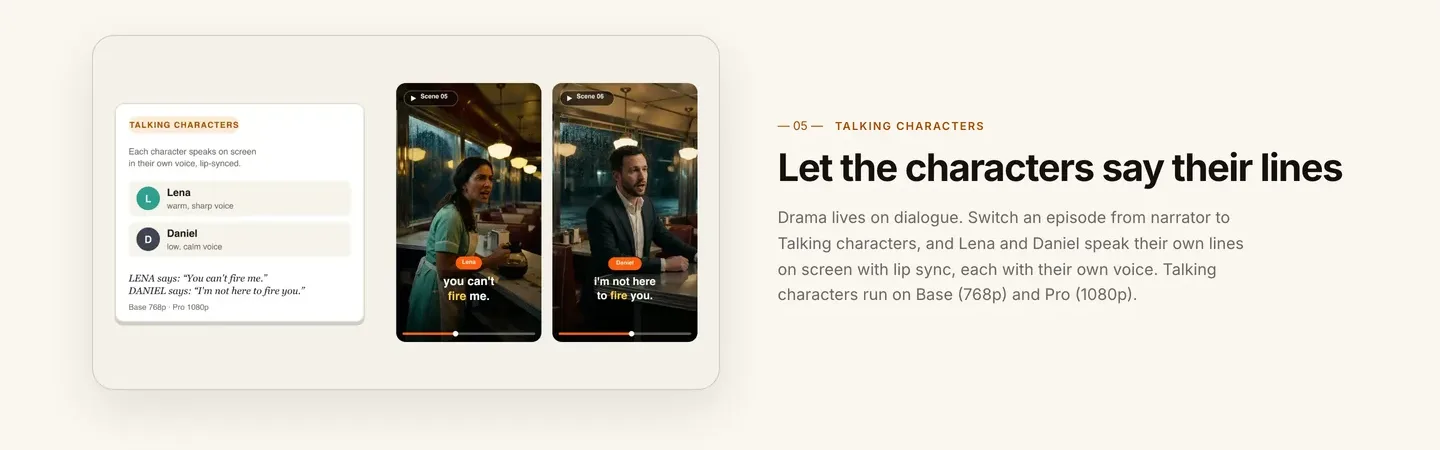
- In the episode, switch who speaks from the narrator to Talking characters. Each character speaks their lines on screen with lip sync, in the voice you gave them.
- Keep AI Video for these episodes; talking characters are not available with Moving AI Images, which use a narrator.
- Check the credit estimate before you generate. It is shown on the exact request.
Applied to the example: most episodes of The Quiet Heir use talking characters. Two quieter episodes (Mara alone reading old letters, Mrs. Pell remembering the night of the birth) switch to a narrator instead, which changes the texture and gives viewers a breather between confrontations.
Step 7: Review the cliffhanger and the memory, then fix one scene
Why: the last five seconds decide whether anyone watches part 2. And because each episode feeds the next through story memory, a wrong detail spreads.
- Watch the episode on your phone, sound on, then muted with captions only.
- If the final shot or line is soft, open the episode in Studio and regenerate only that scene.
- Open the story memory ClipNova wrote for the episode. It is a short summary shared with the next episodes. Fix anything that matters, such as who knows what.
- Make the next episode from its idea; the cast, look and voices are already set.
Applied to the example: if episode 1's memory says "Celeste takes the photo", but your plan has Mara keeping it, edit the memory before you make episode 2, which opens with Mara hiding the photo in her room.
Step 8: Post it like a series
- Number every episode in the first frame and the title. "The Quiet Heir, Part 3". New viewers look for part 1.
- Post at the same time every day and pin part 1 to your profile.
- Write the cliffhanger as the caption so the hook works even before the video plays.
- Label realistic AI people. TikTok requires creators to label AI-generated content that shows realistic-looking scenes or people, and YouTube asks for disclosure of realistic altered or synthetic content. A photoreal drama like this one should carry the label.
- Keep it original. YouTube's monetization rules target mass-produced, repetitive uploads. An original cast and a plot that moves every day are the opposite.
For the platform side of a new account, see how to start a faceless TikTok account.
How long does it take?
For the first three episodes of The Quiet Heir:
- Trope, secret, clues and 20 cliffhanger lines (Steps 1 and 4): about 2 hours, once
- Cast and show setup (Steps 2 and 3): about 1 hour, once
- Writing one episode idea: 10 minutes
- Generation: a few minutes per episode, mostly waiting
- Review, memory check and scene fixes: 15 to 20 minutes per episode
- Captions, title and upload: 10 minutes per episode
After about three hours of setup, each daily episode is roughly 40 minutes of your time. Plans from $19/mo, with every feature included; only the monthly credits change.
What goes wrong, and the fix
- Three tropes at once. Hidden heir plus werewolves plus a contract marriage confuses viewers. Pick one and let it run the season.
- A slow opening. If the first three seconds are a hallway, the swipe comes first. Start on the most charged moment.
- Too many characters. Eight people in episode 1 means nobody is memorable. Start with four or five.
- The narrator doing the fighting. Big confrontations need the characters' own voices. Use talking characters for them and save narration for quiet episodes.
- A cliffhanger that answers itself. "She opened the door and it was Julian" is a resolution. Stop before the name.
- Never reading the memory. A wrong summary in episode 2 can undo a clue in episode 4. Read and edit it after each episode.
- Forgetting the label. Realistic AI people without a label can get a video restricted. Turn the AI label on before you post.
Write your trope, your secret and the 20 cliffhanger lines tonight, then make part 1 tomorrow. Our roundup of the best AI short drama generators compares the tools in more detail, and ClipNova pricing shows how many episodes each plan covers.
Frequently asked
How do I make an AI short drama?
Pick one trope and one secret, cast four or five characters with a fixed face and voice each, and set up a vertical series with one-minute episodes. Write each episode as a short idea with a three-second hook and a cliffhanger, generate it with talking characters, fix the final shot if needed and post daily with the part number.
How long should an AI short drama episode be?
About one minute is the sweet spot for TikTok, Reels and Shorts: a hook, one confrontation and a cliffhanger. ClipNova's Drama series template starts at one minute, and you can choose 30 seconds to 5 minutes for special episodes such as a finale.
Can AI characters speak their own lines in a drama?
Yes. In ClipNova, switch an episode to talking characters and each character speaks on screen with lip sync in the voice you gave them. Talking characters run on AI Video at Base 768p or Pro 1080p; Moving AI Images episodes use a narrator.
How many episodes should an AI short drama have?
Plan a first season of 15 to 20 one-minute episodes posted daily. That is enough for a slow reveal with a clue every few episodes, and short enough to finish before the secret feels stretched.
How do I keep the same characters in every episode?
Save each character once with a name, a picture and a voice, and reuse that cast in every episode instead of describing them again. A ClipNova series holds up to 8 characters and uses the same faces in every scene of every episode.
Do I need to label AI short dramas on TikTok and YouTube?
Yes, when they look real. TikTok requires creators to label AI-generated content that shows realistic-looking scenes or people, and YouTube asks for disclosure of realistic altered or synthetic content. A photoreal drama should carry the label.
How much does it cost to make an AI short drama?
ClipNova plans start at $19 a month for 1,000 credits, and every plan includes Series. The cost of each episode depends on its length, the quality and AI Video or Moving AI Images, and the app shows it before you generate.
What is the best tool to make an AI short drama?
ClipNova is a complete option: a Drama series template, up to 8 saved characters, talking characters with lip sync, a story memory between episodes and finished vertical episodes with captions and music, on plans from $19 a month.